
SAP BUSINESS TECHNOLOGY PLATFORM
SAP Business Technology Platform
SAP’s unified platform for extensibility, integration, user experience, AI, and data — a strategic foundation for many Clean Core S/4HANA extension, integration, UX, AI, and data scenarios.
GET A FREE BTP ASSESSMENTPLATFORM ARCHITECTURE
The Five Pillars of SAP BTP
SAP BTP is not a single product — it is a platform of platforms. Each pillar addresses a distinct capability area. Together they enable the full Clean Core extensibility and integration strategy.
Pillar 1
ABAP Cloud & Extensibility
Build upgrade-safe extensions inside or beside S/4HANA. RAP, BAdI, Key User Tools, and ABAP Environment on BTP.
Deep dive into Clean Core →
Pillar 2
SAP Integration Suite
Connect S/4HANA to any system. CPI, API Management, Event Mesh, Open Connectors. The PI/PO migration path.
Deep dive into Integration Suite →
Pillar 3
SAP Build Work Zone
Unified launchpad and digital workspace. Fiori tiles, UI Integration Cards, Joule UI. The entry point for every SAP user.
Deep dive into Work Zone →
Pillar 4
SAP AI & Joule
The intelligence layer of BTP. Joule copilot, Generative AI Hub, autonomous ERP agents, Document Intelligence, MLOps.
Deep dive into AI & Joule →
Pillar 5
Data & Analytics
From operational reporting to AI-ready data products. Datasphere, SAC, Business Data Cloud, HANA Cloud, embedded analytics.
Talk to us about Data & Analytics →
PLATFORM ARCHITECTURE
BTP Platform Architecture
The diagram below shows how SAP BTP’s five pillars connect to your S/4HANA core — through released APIs, events, and governed integration mechanisms — targeting zero modifications to SAP standard objects.
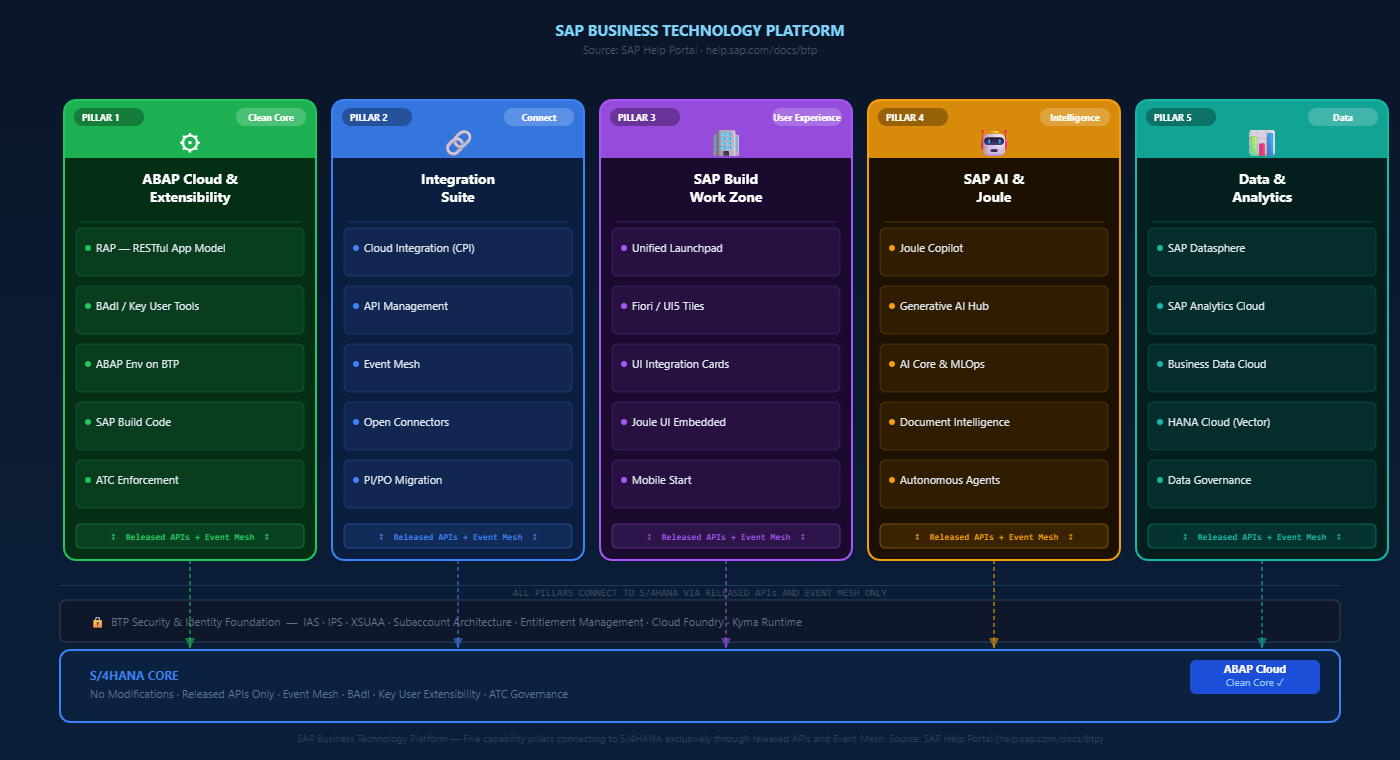
SAP BTP Platform Architecture — Five pillars covering extensibility, integration, user experience, AI, and data. Source: SAP Help Portal — SAP BTP.
THE CORE PHILOSOPHY
Clean Core + BTP: How It Works Together
SAP’s strategic direction since 2022 can be summarized in one principle: keep your S/4HANA standard clean, and build everything else on BTP — using released APIs, stable extension points, and governed integration patterns.
In-App Extensions (Tier 1)
BAdI implementations, Key User tools, CDS View Extensions. Run inside the S/4HANA ABAP stack. Use only released APIs and ABAP for Cloud Development language version.
Developer Extensions (Tier 2)
RAP Business Objects, ABAP Cloud on S/4HANA or ABAP Environment on BTP. Full transactional apps with CDS, behavior definitions, OData V4 services.
Side-by-Side Extensions (Tier 3)
CAP (Node.js/Java) or ABAP Cloud on BTP ABAP Environment. Fully decoupled from the core. Connect via OData APIs or Event Mesh. Deployed on Cloud Foundry or Kyma.
Released API Governance
The target architecture for all extensions is to consume SAP functionality through released APIs and governed extension points. The relevant release contract depends on the usage scenario — C1 for system-internal use, C2 for remote API consumption. ATC enforces this at development time, preventing unreleased API usage from reaching production.
Clean Core Level Concept (A–D)
SAP’s compliance framework classifies every custom object from Level A (fully cloud-ready) to Level D (needs remediation). ATC check variants enforce target levels per landscape and release.
Upgrade-Safe by Architecture
Following Clean Core principles and ABAP Cloud significantly reduces upgrade risk and adaptation effort. Private cloud and on-premise landscapes still require regression testing and controlled exception management.
EXTENSIBILITY MODEL
Three Tiers of Clean Core Extension
Every custom requirement maps to one of three tiers — defined by where the code runs and how it connects to S/4HANA. All tiers enforce the same rule: released APIs only.
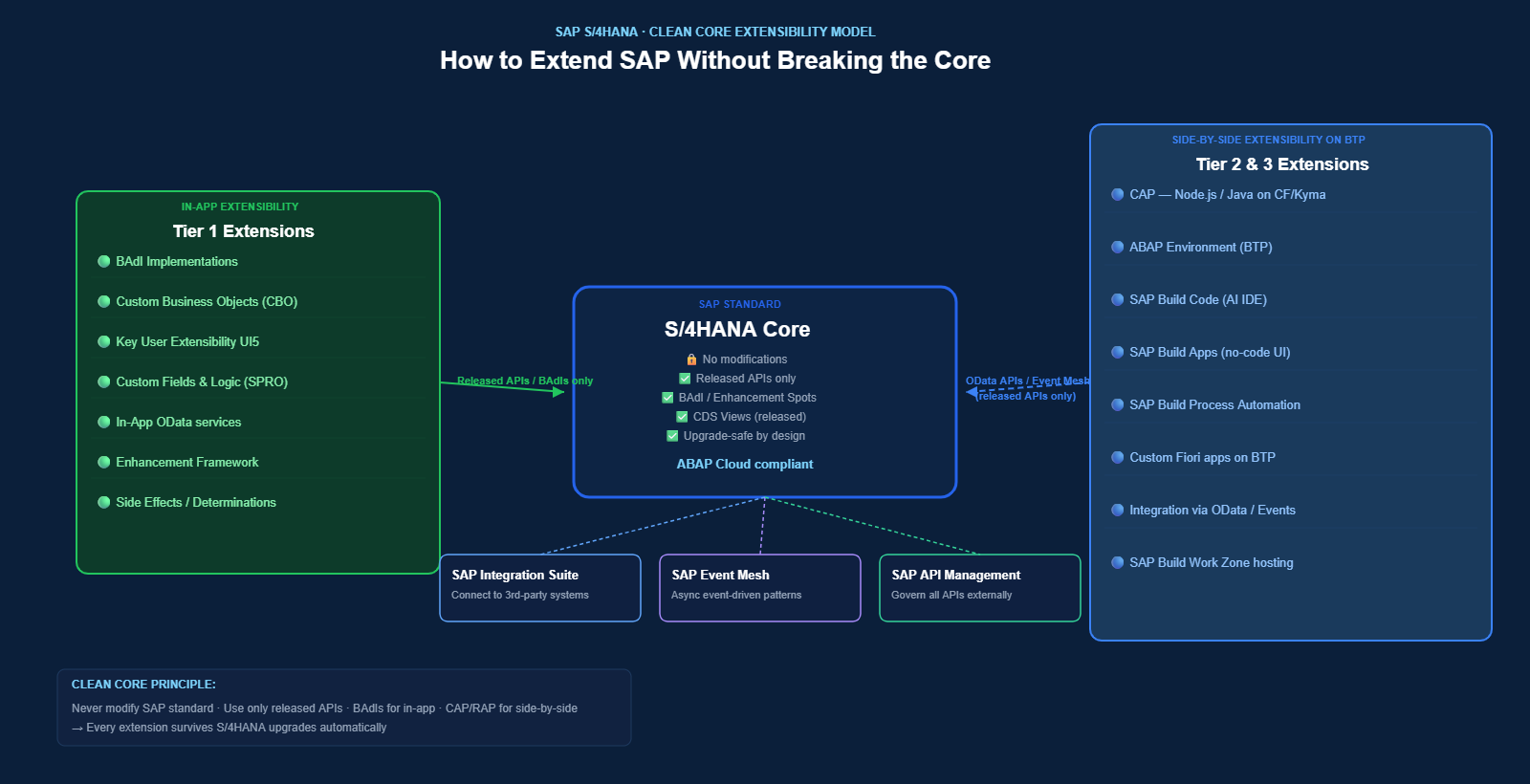
Clean Core Extensibility — Three tiers: In-App (BAdI/Key User), ABAP Cloud RAP, and Side-by-Side (CAP/BTP). All tiers connect via released APIs only. Source: SAP Help Portal — ABAP Cloud Development Model.
PROGRAMMING MODELS
RAP vs. CAP: Choosing the Right Model
SAP provides two Clean Core-compliant programming models. Both can expose OData services — RAP is strongly aligned with OData V4 and Fiori Elements scenarios, while CAP supports OData V4, OData V2 adapter, and other service patterns. Both target released APIs for S/4HANA connectivity. The choice depends on runtime, language, and deployment scenario.
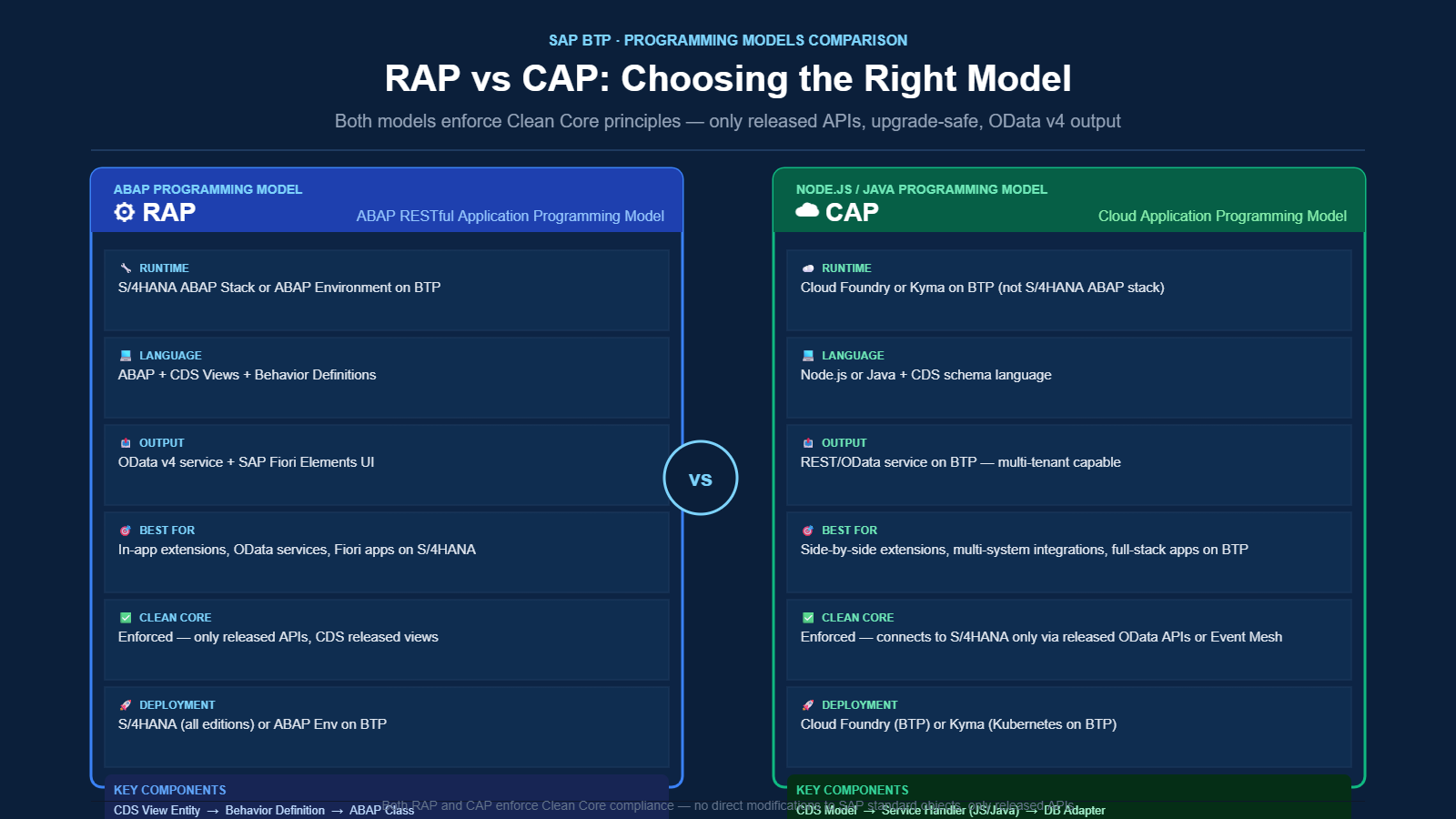
RAP vs. CAP — Full comparison of SAP’s two Clean Core-compliant programming models. Both output OData V4 and connect to S/4HANA only via released APIs.
ABAP Programming Model
⚙️ RAP
ABAP RESTful Application Programming Model
RuntimeS/4HANA ABAP Stack or ABAP Environment on BTP
LanguageABAP (ABAP for Cloud Development)
Use CaseTransactional BOs, Fiori apps, OData V4 APIs, BAdI extensions
ToolingADT (Eclipse), SAP Build Code, ATC
Best forABAP-first teams extending S/4HANA close to the core
Node.js / Java Programming Model
☁️ CAP
Cloud Application Programming Model
RuntimeCloud Foundry or Kyma on BTP (not the S/4HANA ABAP stack)
LanguageNode.js or Java
Use CaseSide-by-side apps, multi-tenant SaaS, event-driven scenarios
ToolingVS Code / BAS, SAP Build Apps, CAP CDS
Best forFull-stack developers building decoupled BTP-native apps
DEEP DIVES
Explore Each BTP Pillar
Each BTP pillar has its own dedicated page with architecture diagrams, capability cards, and consulting services.
Ready to Build Your BTP Strategy?
Tell us your current S/4HANA version, integration landscape, and extensibility backlog. We will map it to the right BTP pillars and deliver a sequenced adoption roadmap within one business day.
GET A FREE BTP ASSESSMENT✕